

RC car suspension tuning is the most overlooked factor in achieving a world-class launch on the drag strip. While many racers focus solely on raw motor power or battery discharge rates, the fastest cars on the track are those that can actually put that power to the pavement. If your chassis is twisting, hopping, or pulling to one side during the first ten feet, you are losing the race before it even begins. This guide explores the physics of weight transfer and the technical adjustments required to turn your 1/10 scale monster into a consistent bracket winner.
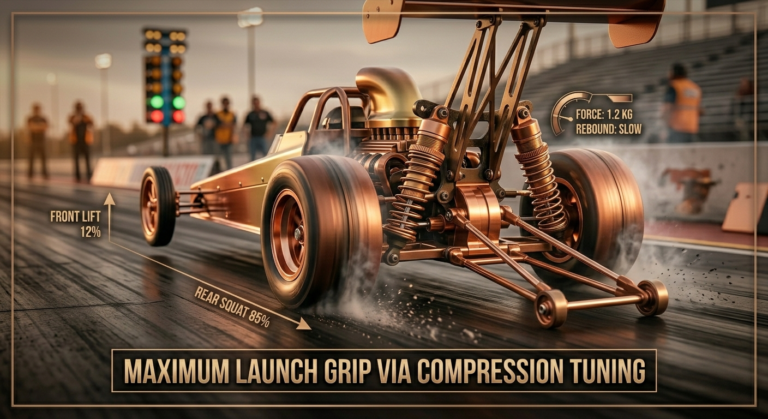
The “hole shot” is won or lost in the first fraction of a second. When the light turns green and the motor torque hits the drivetrain, the physics of inertia want to lift the front of the car and shove the rear tires into the ground. This is known as weight transfer. Proper rc car suspension tuning ensures that this transfer is controlled rather than chaotic. If the rear suspension is too soft, the car will “squat” excessively, which can actually unload the tires after the initial bite and cause a spin. Conversely, if the rear is too stiff, the tires will simply bounce off the surface like a basketball.
In a dedicated drag setup, you want the rear suspension to compress just enough to plant the tires. This compression should be linear and predictable. When you analyze the The 2026 Guide to RC Scale Sizes for drag racing, you realize that 1/10 scale cars have a very specific center of gravity that demands precise spring rates. High-speed cameras often show that a car with poor tuning will “anti-squat,” where the rear of the chassis actually rises, forcing the tires down momentarily before they lose all grip. Your goal is a smooth, dampened compression that holds the weight on the rear axle through the entire 60-foot mark.
While the rear does the heavy lifting for traction, the front suspension manages the air. If the front end lifts too high during the launch, air gets underneath the chassis, creating lift. This reduces steering control and can lead to a catastrophic blow-over at high speeds. You want the front suspension to have very limited travel—just enough to soak up tiny bumps in the asphalt without allowing the nose to pitch up. Many professional racers use internal travel limiters or heavy “droop” settings to keep the front end pinned to the track.
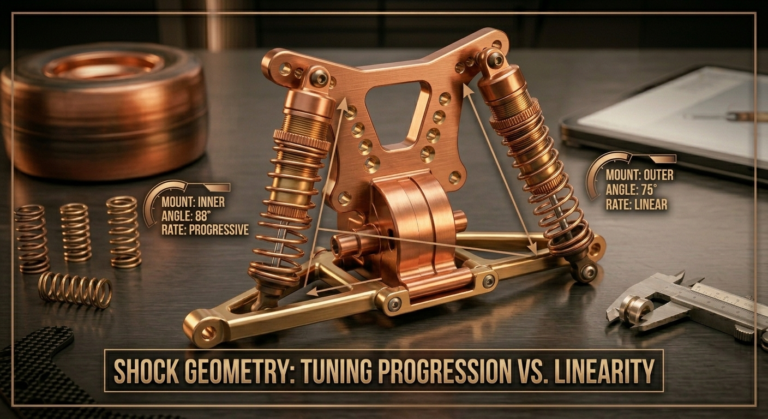
The geometry of your shocks determines how leverage is applied to the tires. If you stand your shocks up vertically, they provide a more direct and stiff response. If you lay them down at an angle, the suspension becomes more progressive, meaning it gets stiffer the further it compresses. Finding the right angle is one of the most effective rc drag racing tuning tips for varying track conditions.
Shock oil acts as the brain of your suspension. It controls the speed at which the suspension compresses and rebounds. For drag racing, you typically want heavier oil in the rear to slow down the initial squat. This prevents the car from “slamming” the rear down, which often results in a bounce that breaks traction. Standard bashers might use 30wt oil, but a dedicated drag car might see 80wt or even 100wt oil depending on the ambient temperature and the grip level of the track.
Springs support the weight of the car, while oil controls the movement. In your Ultimate Guide to RC Drag Racing Parts for Maximum Speed, we discussed the importance of lightweight components. Lightweight cars require softer springs to actually engage the suspension. If your springs are too stiff for your light carbon fiber chassis, the car will be skittish and prone to flipping. You want a spring that allows the car to sit at “ride height” with the suspension slightly compressed, giving it room to work in both directions.
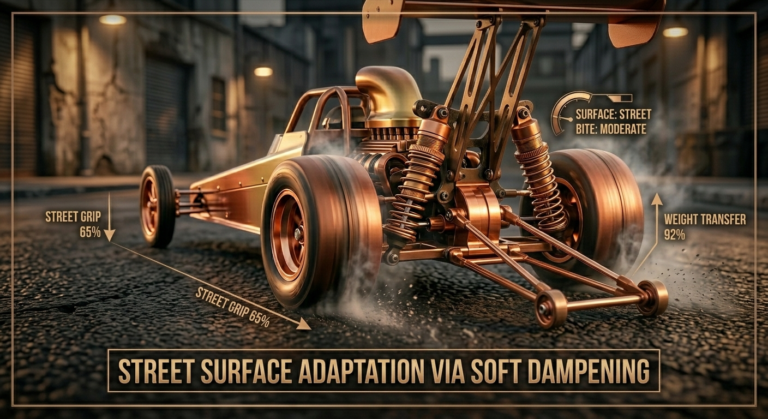
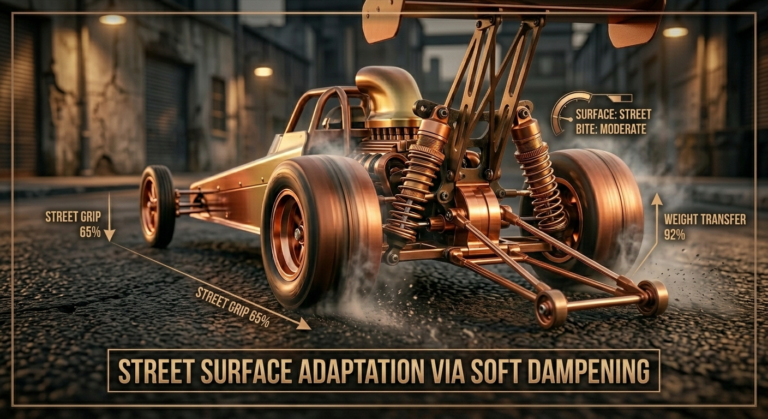
No-prep racing is a different beast entirely. Unlike a prepared track with traction compound, the street is dusty, uneven, and unpredictable. Applying no prep rc drag racing setup tips is about finding “bite” where there is none. On the street, you generally want a slightly softer overall setup to allow the car to conform to the imperfections of the road rather than bouncing over them.
Ride height is the distance between the bottom of the chassis and the ground. In drag racing, you want the rear to be slightly lower than the front, creating a “rake.” This helps keep the air pushing the nose down as you accelerate. However, you must ensure that under full squat, the chassis does not actually hit the ground. If the carbon fiber plate touches the asphalt, it will act like a pivot point and immediately unload the tires, causing a spin. Check your sag by dropping the car from about six inches and seeing where it settles.
Camber refers to the tilt of the tires. For drag racing, you want “zero camber,” meaning the tires are perfectly flat on the ground to provide the largest possible contact patch. Caster, on the other hand, is the angle of the steering kingpin. Increasing positive caster helps the car “self-center,” making it much easier to keep the car in a straight line as it crosses the 100-foot mark. This is vital when you are running at the limits of your RC Drag Racing Chassis: Carbon Fiber vs. Aluminum performance.
Camber refers to the tilt of the tires. For drag racing, you want “zero camber,” meaning the tires are perfectly flat on the ground to provide the largest possible contact patch. Caster, on the other hand, is the angle of the steering kingpin. Increasing positive caster helps the car “self-center,” making it much easier to keep the car in a straight line as it crosses the 100-foot mark. This is vital when you are running at the limits of your RC Drag Racing Chassis: Carbon Fiber vs. Aluminum performance.
Compression is the shock moving in; rebound is the shock moving out. In a drag car, you want fast compression in the rear to get the weight back quickly, but slow rebound to keep the weight there as long as possible. This “holds” the car down during the transition from the launch to the mid-track. If the rebound is too fast, the rear end will “pop” back up the moment you let off the throttle or hit a small dip, which can be dangerous at 60+ mph.
Power wheelies look cool, but they lose races. When the front tires leave the ground, you lose all steering control and your aerodynamics become a sail. Internal shock limiters are small spacers placed inside the shock body that physically prevent the shock from extending past a certain point. By limiting the front shock extension, you can “tie down” the front end. This is one of the most effective mechanical ways to keep the car flat and fast.
Before you head to the next event, use this rc drag racing setup guide to verify your settings. Start with your ride height and ensure your rake is correct. Check that your rear shocks have the appropriate oil weight for the day’s temperature—remember that oil gets thinner as it gets hotter. Finally, ensure your wheelie bar is set to a height that catches the car just before the front wheels lose significant contact.
If you are looking for the best rc drag racing upgrades, focus on adjustable shocks and a variety of spring rates. The ability to tune your suspension on the fly is what separates the winners from the “also-rans.” For those looking for more technical data on high-speed stability, the ROAR Racing professional guidelines offer excellent insights into sanctioned racing standards.
Suspension tuning is a journey of trial and error. Keep a logbook of your changes, noting the track temperature and the resulting ET (Elapsed Time). Over time, you will develop a “feel” for what the car needs. Whether you are racing on a prepped track or a dusty backstreet, mastering the science of the launch is your fastest ticket to the winner’s circle. Stop chasing horsepower and start chasing traction through superior suspension management.
© 2026 Supa Media. All rights reserved.
Supa Speed RC