

RC Drag Racing Aero dictates whether your car stays pinned or takes flight at 80+ mph. While mechanical grip launches the car, aerodynamic stability finishes the race. Understanding how air moves around your body shell is the difference between a record pass and a catastrophic backflip. At triple-digit scale speeds, your RC car isn’t just a vehicle; it’s an airfoil that requires precise management to stay grounded. Every millimeter of polycarbonate surface acts as a flight control surface.
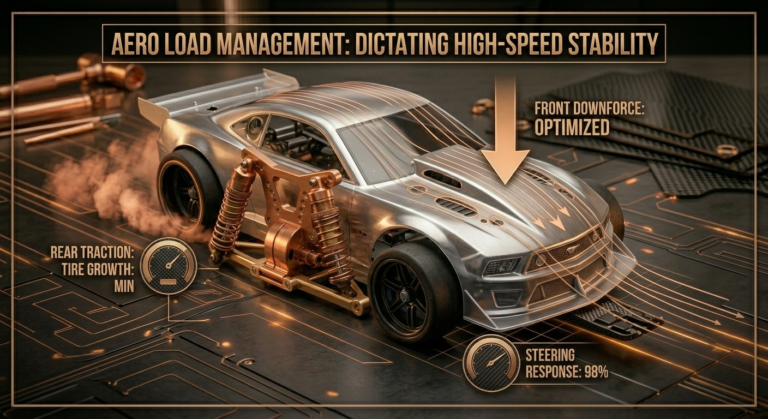
As your velocity increases, air becomes a physical wall. RC Drag Racing Aero management ensures this air works for you rather than against your chassis. Without proper downforce, the front end lightens, causing a loss of steering and high-speed “blowovers.” This phenomenon occurs because the underside of an RC car is often flat, acting like a wing that generates lift as air speed increases. When air pressure under the car exceeds the pressure on top, the front wheels lose contact, and the run is over.
At the start line, your shocks and tires do the heavy lifting. The weight transfer to the rear tires provides the “bite” needed for the hole shot. However, once you cross the 40 mph threshold, the physics of the run shift. The body shell takes over as the primary stabilizer. High-pressure air must stay on top of the hood to keep the front tires engaged with the track surface. If the front end lifts even a few millimeters, air rushes underneath, compounding the lift and leading to a crash.
Air trapped under the body creates a massive lift force. This “parachute effect” occurs when high-speed air enters the front bumper or wheel wells and has no exit path. It creates an internal pressure bubble that can literally lift the car off the ground mid-track. To combat this, elite racers use strategic venting to “bleed” this internal pressure without sacrificing the external downforce generated by the body’s shape. You are essentially turning the body into a pressure-relief valve.
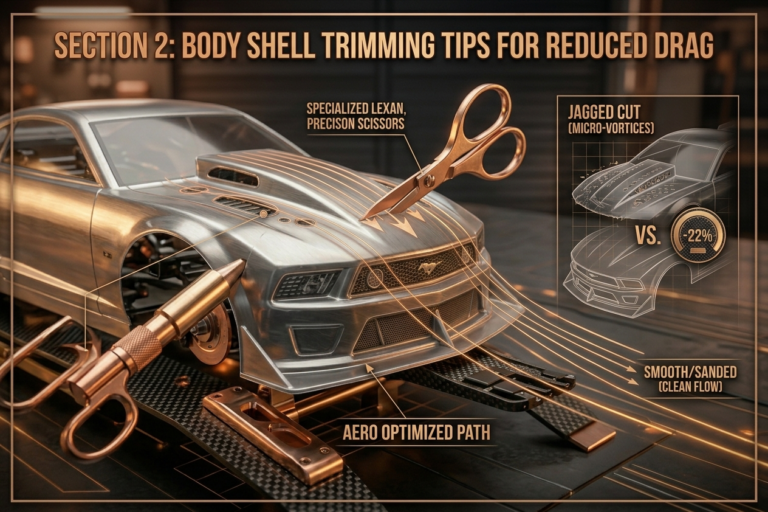
Achieving the perfect RC Drag Racing Aero profile requires precise trimming. You want the body to sit as low as possible without interfering with suspension travel. A lower profile reduces the frontal area, which directly lowers the drag coefficient of your build. Every millimeter the body sits above the ground allows more air to enter the “dead zone” under the chassis, increasing the risk of instability. Professional racers often use “body slam” techniques to minimize this gap.
Setting the front of the body slightly lower than the rear creates “rake.” This downward angle forces air over the roof rather than under the chassis. Even a 2mm difference in body height can significantly improve high-speed tracking on dusty street surfaces.
Pro-Tip for Rake Setup:
A sharp, well-defined front splitter is essential for cutting the air. It divides the air stream, sending the majority over the hood to create downforce. In “No Prep” racing, splitters are often reinforced with carbon fiber or stiff polycarbonate to prevent deformation. If your splitter flexes downward at high speed, it acts as a scoop, catching air and flipping the car. If it flexes upward, you lose all front-end downforce. A rigid splitter is a non-negotiable requirement for 100 mph passes.
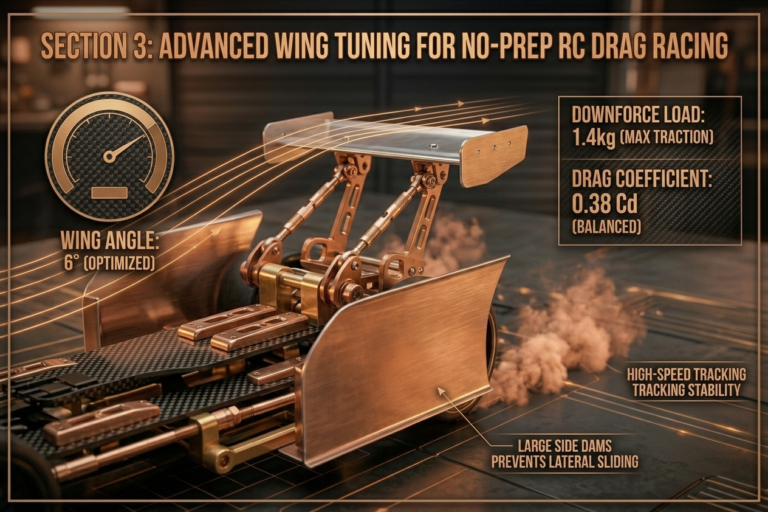
Rear wings are the primary tool for fine-tuning RC Drag Racing Aero balance. In No-Prep racing, where traction is limited, you need enough wing to keep the rear planted without creating so much drag that you lose top-end speed. The goal is to maximize the “Lift-to-Drag” ratio. A wing that is too steep will act as an air brake, while a wing that is too flat will allow the rear tires to spin at high velocity.
Too much rear wing angle creates a pivot point. At extreme speeds, the rear downforce can actually act as a lever, lifting the front tires off the ground. This is especially dangerous at the 132-foot mark where the car is at maximum velocity. You must find the “sweet spot” where the car feels heavy and stable through the traps without “parachuting” the rear end. Constant testing and angle adjustments are the only ways to find this balance for your specific chassis.
Side dams on your rear wing act like the feathers on an arrow. They provide lateral stability, preventing the rear end from “fishing” or sliding side-to-side. High-speed stability depends on these vertical surfaces to keep the car’s momentum moving in a perfectly straight line. For street racing, larger side dams are often preferred to compensate for crosswinds and uneven surfaces. They act as a rudder, keeping the car pointed toward the finish line regardless of surface imperfections.
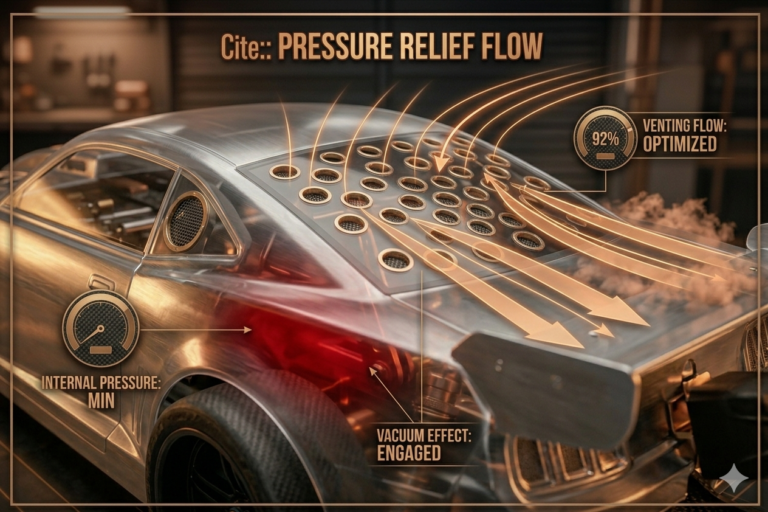
Venting is the most misunderstood aspect of RC Drag Racing Aero. Many beginners cut holes randomly, which can actually ruin the car’s aerodynamics. The goal is to remove high-pressure air from inside the body without creating turbulence on the outside. Proper venting maintains the vacuum effect under the car, which pulls the chassis closer to the track.
Air naturally wants to move from high-pressure areas to low-pressure areas. The rear deck and the rear window are typically low-pressure zones. Cutting vents here allows the “trapped” air under the hood to flow through the car and exit out the back.
Don’t use a hobby knife for vents; it leads to jagged edges that cause turbulence.
The weight of your body shell significantly impacts your center of gravity. While a heavy body is more durable, it raises the center of gravity, making the car prone to rolling or swaying.
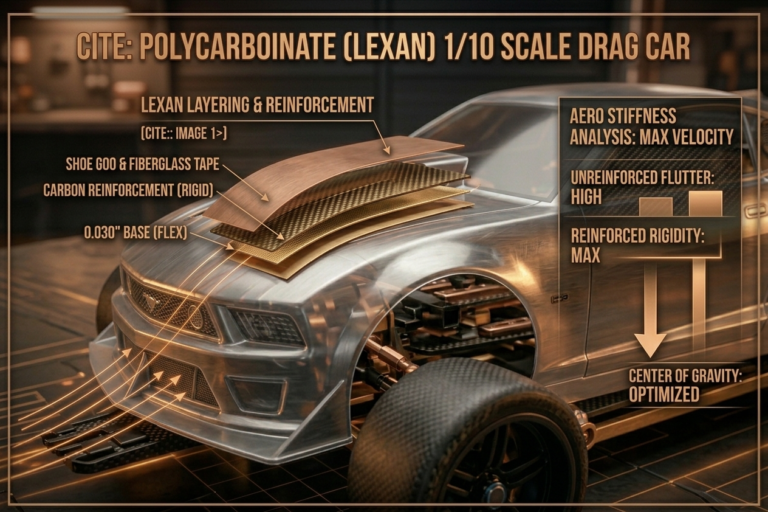
To prevent a thin body from collapsing under RC Drag Racing Aero loads, use “shoe goo” and fiberglass tape in high-stress areas. Reinforce the areas where the body posts meet the shell and the underside of the front splitter. This keeps the aerodynamic shape consistent throughout the entire 132-foot pass. If the hood caves in during a run, it changes the airflow entirely, usually resulting in a sudden loss of control.

If your ESC or radio system supports data logging, pay close attention to your RPM vs. speed curves. A sudden spike in RPM without a corresponding increase in speed often indicates “tire growth” or the front end lifting.
Professional teams use “clay testing” or string indicators to see where air is detaching from the body shell. If you see your car “hunting” (moving side to side) at high speed, your side dams are likely too small. If the car feels light or “floaty,” you need more front downforce or better venting to relieve the internal pressure.
At 100 mph, a 1/10 scale car is moving at a massive scale velocity. The forces applied to the body are hundreds of times greater than they are at 30 mph. You must inspect your body mounts and splitter after every run. Stress cracks in the Lexan can become failure points during the next pass.
© 2026 Supa Media. All rights reserved.
Supa Speed RC