
๐Ÿ“ฆ Free Shipping on Orders Over $100!     ๐Ÿ•’ Limited Time Offer โ€“ Hurry Up!                   ๐Ÿ“ฆ Free Shipping on Orders Over $100!     ๐Ÿ•’ Limited Time Offer โ€“ Hurry Up!                   ๐Ÿ“ฆ Free Shipping on Orders Over $100!     ๐Ÿ•’ Limited Time Offer โ€“ Hurry Up!    

The 2026 Guide to RC Scale Sizes: Why 1/10 Dominates the Strip

rc scale sizes represent the most fundamental decision any hobbyist makes before purchasing their first professional vehicle. Most enthusiasts realize that the physical dimensions of a vehicle dictate where it can race and how it handles high-speed maneuvers. Choosing the wrong footprint can lead to poor stability on the track or a lack of compatible aftermarket components. This comprehensive guide explores why the industry has gravitated toward specific dimensions for competitive events. We will analyze the physics of scale to help you select the perfect foundation for your next high-performance build.
Understanding Common RC Scale Sizes for Competition

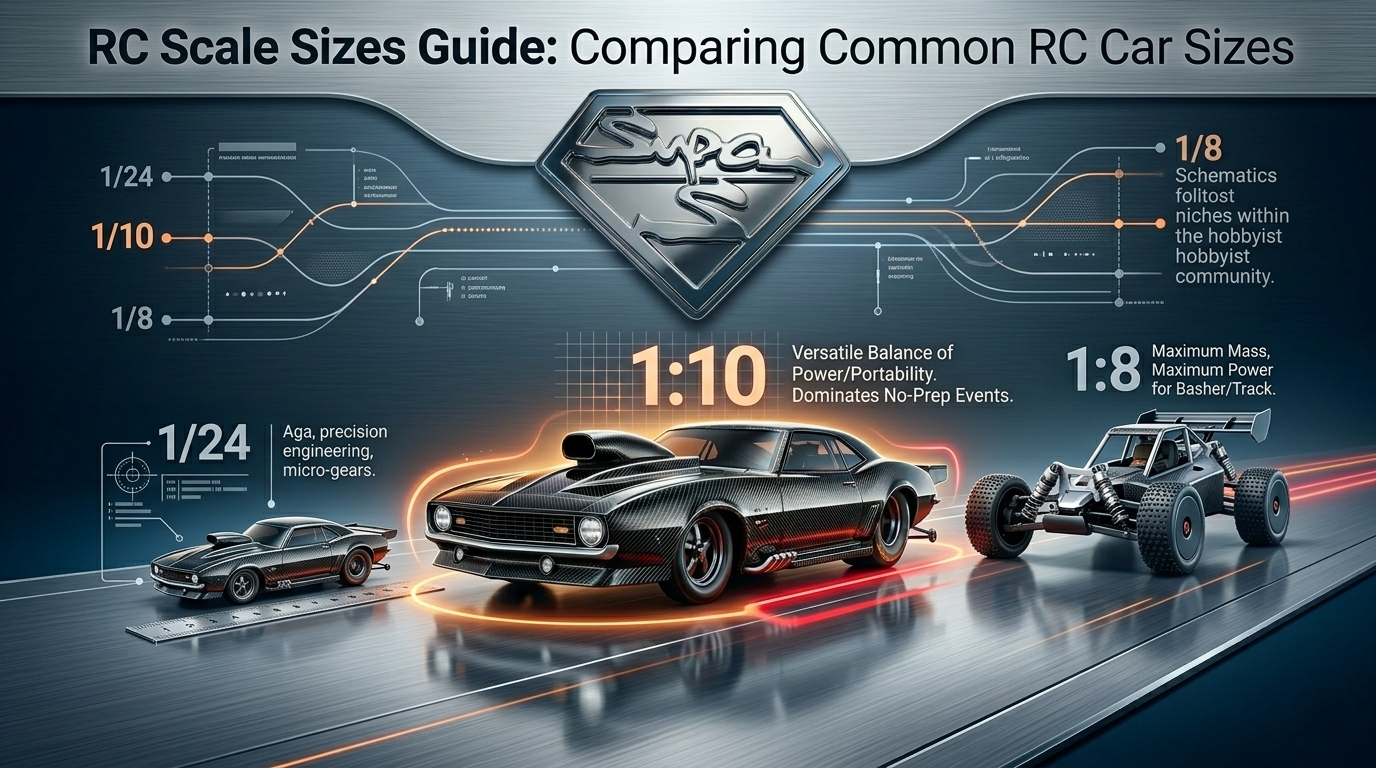
A professional 1/10 scale rc scale sizes positioned at the starting line of a no-prep event

The industry uses a fractional system to categorize the dimensions of every vehicle relative to its full-scale counterpart. Most people are familiar with 1/10 scale because it offers the most versatile balance of power and portability. However, the market also supports everything from tiny 1/24 micro-racers to massive 1/5 scale gasoline-powered monsters. Each of these categories serves a specific niche within the hobbyist community. Professional racers typically focus on a single scale to ensure their tools and spare parts remain compatible across their entire fleet.

How RC Car Sizes Impact Physics

Larger vehicles naturally handle rougher terrain because their mass helps them plow through obstacles. Conversely, smaller cars require a much smoother surface to maintain their speed without flipping. The weight of the vehicle also determines how much torque is required to achieve a rapid launch from a standstill. You must consider the surface of your local track when deciding between different rc scale sizes for your collection. A car that is too small for a bumpy track will bounce uncontrollably at full throttle.

The Rise of 1/10 Scale Dominance

The 1/10 scale has become the global standard for both on-road and off-road racing events. This size is large enough to house high-voltage electronics while remaining small enough to transport easily in a standard backpack. Manufacturers prioritize this scale because it allows for high-detail body shells and realistic suspension geometries. Consequently, the aftermarket support for this specific size is significantly greater than any other category. Most no-prep events are designed specifically for this footprint to ensure a level playing field for all participants.
Why 1/10 Scale Dominates the Drag Race Car Scene

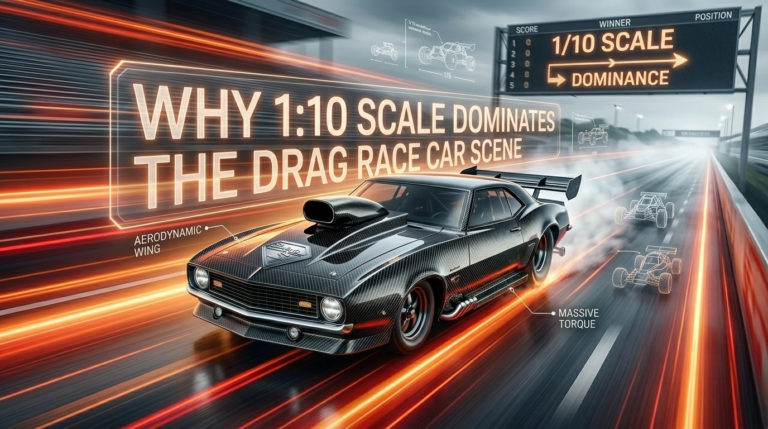
A professional 1/10 scale drag race car positioned at the starting line of a no-prep event.

The competitive world of street racing has almost entirely standardized on the 1/10 scale format. This consistency allows organizers to set strict rules regarding wheelbases and tire widths. A drag race car built on this scale provides enough chassis surface area to mount heavy-duty brass weights for better traction. Furthermore, the distance between the axles on a 1/10 model offers the ideal leverage for managing high-torque brushless motors. Smaller scales often struggle to keep their front wheels on the ground under extreme acceleration.

Engineering Your Drag Race Car for Stability

Stability is the primary concern when you are traveling at speeds exceeding sixty miles per hour. A 1/10 scale drag race car has a wider track width which helps prevent rolling during high-speed steering corrections. This size also allows for larger aerodynamic wings that generate meaningful downforce at the rear of the vehicle. Engineers can fine-tune the center of gravity more effectively on a mid-sized chassis than on a micro-scale platform. As a result, the most consistent winners on the strip are almost always utilizing this specific footprint

Comparing Different RC Car Sizes for Speed

While 1/8 scale cars can reach higher absolute top speeds due to their massive motors, they often lack the nimbleness of their smaller counterparts. The 1/10 scale remains the sweet spot for achieving the best power-to-weight ratio in a standard racing environment. You can utilize high-discharge LiPo batteries that provide enough current for explosive launches without adding excessive bulk. Most hobbyists find that these rc car sizes offer the most rewarding driving experience for both practice and competition

Exploring Off-Road RC Cars and Scalability

Diverse rc car sizes lined up to show the footprint of 1/24, 1/10, and 1/8 scale models.

Off-road environments demand a higher level of ground clearance and suspension travel than a flat drag strip. Most off-road rc cars utilize larger tires and longer shocks to absorb the impact of jumps and rocky terrain. This requirement often makes 1/8 scale a popular choice for basher enthusiasts who race in parks or construction sites. However, the 1/10 scale remains the king of organized track racing due to its agility in tight corners. Choosing the right scale for off-road use depends heavily on the intensity of the obstacles you plan to navigate.

Suspension Geometry in Off-Road RC Cars

A larger scale allows for more complex suspension components that mimic the behavior of full-sized trophy trucks. You can adjust the camber, toe, and caster with much greater precision on a 1/10 or 1/8 scale vehicle. Tiny 1/24 off-road rc cars often lack these tuning options, which limits their performance on technical tracks. Therefore, serious competitors invest in larger scales to gain access to professional-grade tuning hardware. These adjustments are vital for maintaining control when the tires leave the ground during a jump.

Durability Concerns Across Various RC Car Sizes

Mass is the enemy of durability when it comes to high-impact crashes. A 1/5 scale vehicle carries immense kinetic energy, which often results in broken parts during a collision. Smaller rc car sizes are generally more resilient because they have less weight pulling against their plastic and metal components. You must balance your desire for a realistic size with the practical reality of maintenance costs. Most beginners should start with 1/10 scale to minimize the expense of replacement parts while learning the ropes.

Technical Specifications of Popular RC Scale Sizes

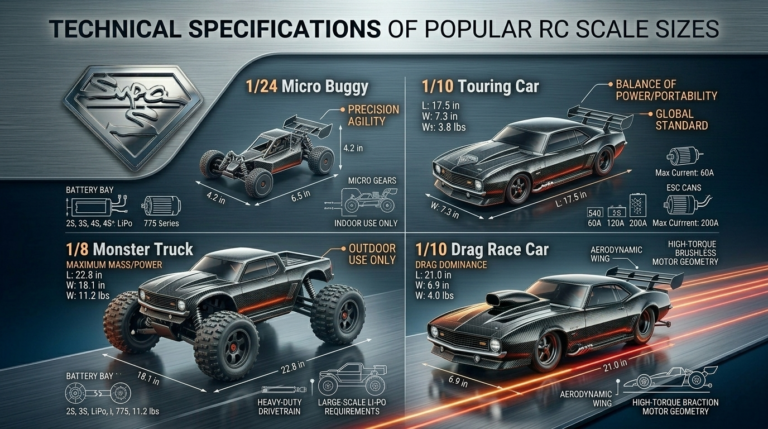
Understanding the actual measurements of these vehicles is crucial for selecting the right storage and transport solutions. A standard 1/10 scale touring car is approximately 14 to 18 inches long. In contrast, a 1/8 scale monster truck can exceed 24 inches in length and weigh over 10 pounds. These differences in rc scale sizes also impact the type of charger and battery equipment you will need to purchase. Always check the physical dimensions of a vehicle before ordering a custom body shell or chassis protector.

Matching Electronics to RC Car Sizes

The motor and speed controller must be appropriately sized for the mass of the vehicle. A motor designed for 1/10 rc car sizes will quickly overheat if installed in a heavy 1/8 scale chassis. Conversely, putting a massive 1/8 scale motor into a small car will likely strip the gears and make the car undriveable. You should follow the manufacturer’s recommendations to ensure your electronics operate within their optimal temperature range. This logical approach to component selection prevents costly failures during a race.

Battery Requirements for a Drag Race Car

High-speed runs require a battery that can deliver a massive amount of current in a very short time. A 1/10 scale drag race car usually runs on a 2S or 3S LiPo battery with a high C rating. Larger scales often require 4S or even 6S configurations to move their heavier frames effectively. These higher voltages increase the complexity and cost of your charging setup. Most hobbyists find the 1/10 scale power requirements to be the most manageable for a daily driver or a weekend racer.

Finalizing Your Choice in RC Scale Sizes

Selecting your primary scale is a long-term commitment that influences every future purchase in the hobby. You should look at what other people are racing at your local track to ensure you have a class to compete in. Most clubs in the US focus on 1/10 scale because of the availability of parts and tires. Once you settle on a scale, you can begin the deep-dive into performance tuning and custom modifications. For more on optimizing your build, check out the Ultimate Guide to RC Drag Racing Parts for Maximum Speed.

The Strategic Value of Standardization

Sticking to one of the common rc scale sizes allows you to share batteries and tools between multiple vehicles. This efficiency reduces the overall cost of the hobby and simplifies your pit bag for race days. If you own three different 1/10 scale cars, you only need one set of high-quality hex drivers and one professional charger. This System Architect approach to your hobby ensures that you spend more time racing and less time searching for the right tool.

Future Trends in RC Car Sizes

We are seeing a shift toward even more specialized dimensions as the hobby becomes more professionalized. However, the 1/10 scale appears to be a strategic anchor that will not be displaced anytime soon. New materials like aluminum frames are making these cars faster and stronger than ever before. If you are building a digital marketing strategy for a hobby shop, you might find useful tips in . Staying informed about these trends will help you remain competitive in the ever-evolving world of RC racing. If you are a seller or planning to sell,ย  check out Ecommerce SEO for Niche Hobbyist Brands